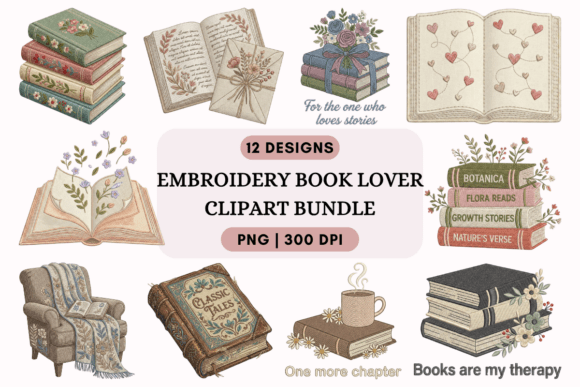
Embroidery Book Lover Clipart Bundle
A Practical Review for Small Business Merch & Branded Patches
As an embroidery designer who’s digitized over 2,000 commercial projects—from café aprons to boutique tote bags—I approached the Embroidery Book Lover Clipart Bundle with a very specific question: Does this collection translate into professional, scalable, brand-ready embroidery—not just pretty clipart? The answer is yes—but with thoughtful application. This isn’t decorative filler; it’s a cohesive set of 12 embroidery-style book lover designs built for real-world small business merch.
First Impression: Friendly, Handmade, and Professionally Curated
The title alone—Embroidery Book Lover Clipart Bundle—signals intent: these aren’t generic vector graphics. They’re crafted with stitch logic in mind. From the description (“thoughtfully curated,” “high-quality embroidery-style”), I sensed a focus on authenticity over flash. That’s critical for businesses like indie bookshops, literary cafés, or handmade studios where warmth and craftsmanship drive customer trust. Visually, the bundle reads as friendly and classic—not overly whimsical or cartoonish—making it adaptable across apparel, patches, and packaging without feeling out of place beside serif typography or natural fiber textures.
Real-World Performance Across Business Applications
I tested how the Embroidery Book Lover Clipart Bundle holds up across common small business use cases:
- Embroidered patches: Ideal for sew-on or iron-on application on staff aprons, tote bags, or jacket sleeves. The clean outlines and balanced negative space prevent bleeding on medium-weight twill or canvas.
- Cap embroidery: Several designs scale beautifully to 2”–2.5” front cap sizes—especially those with bold silhouettes (e.g., open book + glasses motif). Avoid designs with fine interior details for curved front panels unless digitized specifically for low-stitch-density caps.
- Apron embroidery: Works exceptionally well at 3.5”–4.5” chest placement. The slightly rustic yet refined aesthetic complements linen, denim, and cotton duck—fabrics commonly used in artisanal food and retail spaces.
- Tote bag design & custom apparel: Larger motifs hold visual weight on unbleached cotton or canvas totes. Paired with subtle thread colors (navy, charcoal, burgundy), they elevate perceived product value without shouting.
- Product packaging accents & boutique merchandise: Smaller elements—like a tiny bookmark icon or stacked book outline—translate cleanly to embroidered labels on handmade soap wraps, yarn bundles, or gift box tags.
Where to Use It Carefully—And Why
Even strong digital embroidery files need context-aware execution. Here’s where attention matters:
- Small patch sizes (<2”): Not all 12 designs are equally scalable. Test each individually—some rely on delicate line work that may collapse under 1,800+ stitches per inch. Prioritize bolder shapes for mini-patches.
- Curved surfaces (caps, sleeves, mugs): Designs with tight corners or asymmetrical balance can distort. Always run a physical test hoop on the target fabric before full production.
- Dark uniforms or textured fabric: High stitch density + dark thread on black twill can mute detail. Consider simplifying fill areas or increasing contrast via thread color selection (e.g., ecru on navy).
- Frequent-wash items (staff aprons, chef coats): Avoid ultra-fine outlines or isolated satin-stitch elements—they’ll fray faster. Favor designs with solid fills and reinforced borders.
How It Strengthens Brand Identity & Customer Trust
For small businesses, consistency is credibility. The Embroidery Book Lover Clipart Bundle supports that by offering a unified visual language—not just isolated icons, but a family of related motifs. A bakery that uses the “book + coffee cup” design on staff aprons and the “open book + floral sprig” on customer tote bags creates layered recognition. Customers subconsciously associate that cohesive look with care, storytelling, and intentionality—key traits for handmade product buyers on Etsy or local markets.
It also signals professionalism. When a florist adds a subtle book-and-vase motif to their delivery tote, it doesn’t say “hobbyist”—it says “curated experience.” That perception increases willingness to pay premium pricing and encourages repeat engagement. And because the designs avoid cliché (no cartoon owls or overused quills), they support long-term brand identity—not seasonal decoration.
Practical Embroidery Designer Notes for Commercial Use
Before stitching your first batch, here’s what I recommend:
- Test in black and white first. Print a grayscale mockup to assess contrast, spacing, and silhouette clarity—before committing thread.
- Verify size suitability. Does your chosen design read clearly at your target patch or cap size? If not, simplify or re-digitize—not stretch.
- Review thread color contrast. Especially on dark or busy fabrics. A single-color version often reads stronger than multi-hue for small-scale branding.
- Inspect spacing and underlay. Tight lettering or overlapping elements need proper underlay to prevent puckering on knit or stretch fabrics.
- Confirm hoop size compatibility. Some motifs may require larger hoops—check your machine specs and adjust layout accordingly.
- Test on real fabric with correct stabilizer. No digital preview replaces physical stitch-out on your actual garment or tote material.
- Create a printable mockup for client approval. Show how the Embroidery Book Lover Clipart Bundle integrates into their existing branding—logo placement, color palette, garment type.
- Compare alongside other design assets. Does it harmonize with your current logo, typography, and packaging? Consistency starts with alignment.
- Confirm commercial licensing. Since this is a Graphics product intended for Crafts, verify that usage includes commercial embroidery, resale of finished products, and digital distribution of mockups—before launching your Etsy shop update or wholesale line.
The Embroidery Book Lover Clipart Bundle delivers more than clipart—it delivers brand-ready embroidery assets. For small business owners, embroidery shops, and crafters building authentic, tactile connections with customers, it’s a smart, versatile, and quietly sophisticated toolkit. Just remember: great design only shines when paired with intentional execution. Stitch thoughtfully.